← MeoMock / Written exams
ETO ETO Exam papers 📅 Jan 2022

Exam Question

Briefly explain the Principle of Operation of Variable Frequency Drives (VFD) Discuss the advantages and disadvantages of VFDs onboard merchant vessels? (16)
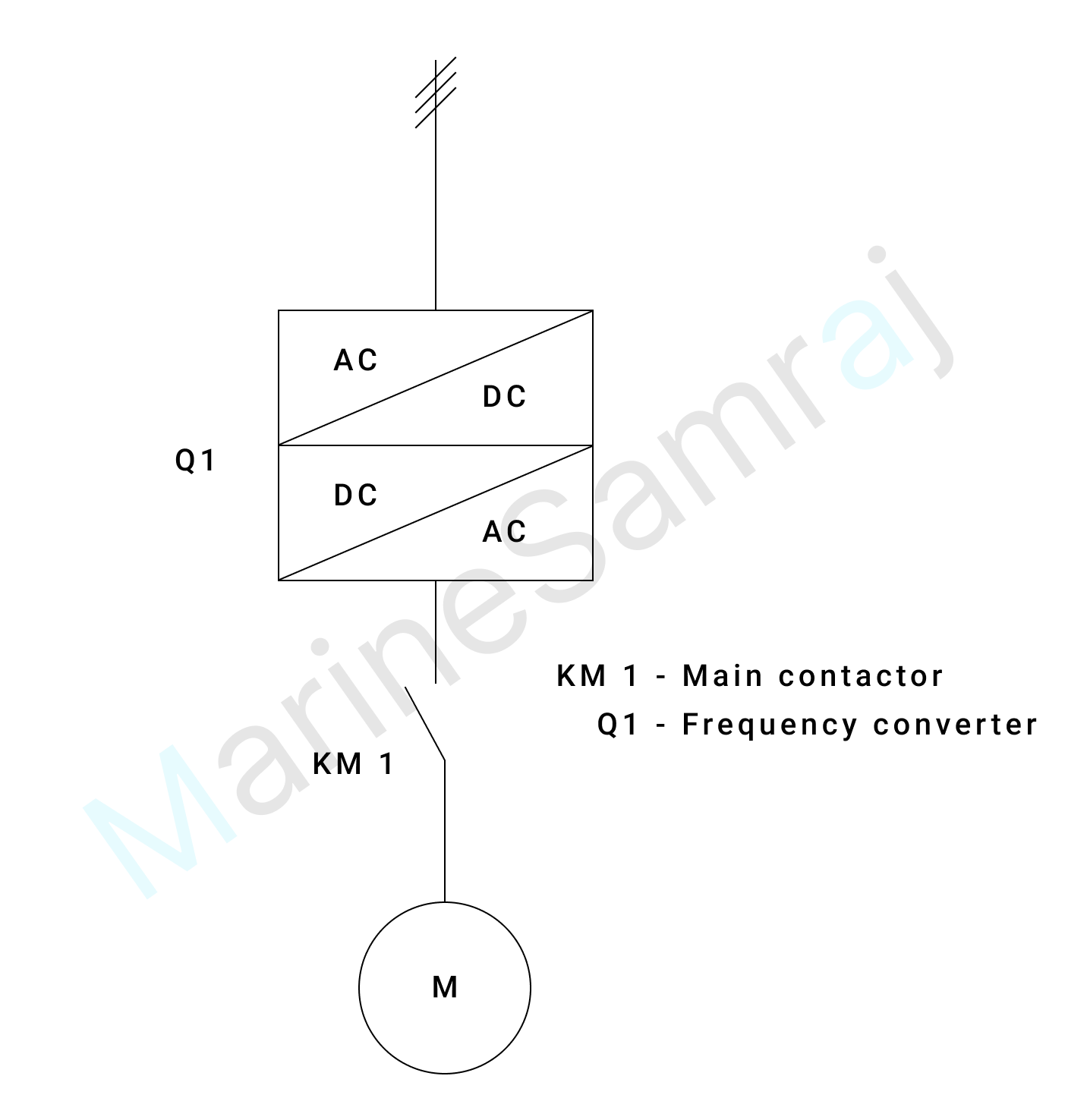
Exam question diagram

Reference Answer

A variable frequency drive controls the speed of an AC motor by varying the frequency supplied to the motor. The drive consists primarily of two parts, one which converts AC (50 or 60 Hz) to DC and the second part which converts the DC back to AC, but now with a variable frequency of 0 - 250Hz.
The first step in this process is to convert the AC supply voltage into DC by the use of a rectifier. DC power contains voltage ripples which are smoothed using filter capacitors. This section of the VFD is often referred to as the DC link.
This DC voltage is then converted back into AC. This conversion is typically achieved through the use of power electronic devices such as IGBT power transistors using a technique called Pulse Width Modulation (PWM). The output voltage is turned on and off at a high frequency, with the duration of on-time, or width of the pulse, controlled to approximate a sinusoidal waveform.
Advantage of VFD

Full answer on MeoMock — surveyor-grade reference answers for 7,000+ written exam questions.

View plans Browse library

← Browse more questions

Prepare on Android — MeoMock on Google Play