← MeoMock / Written exams
ETO ETO Exam papers 📅 Dec 2023

Exam Question

(a) Explain the significance of the root-mean-square value of an alternating current or voltage waveform. Define the form factor of such a wave form. (6).

(b) A 72 KVA transformer supplies a heating and lighting load of 12 kW at unity power factor and a motor load of 70 kVA at 0.766 (lagging) power factor. Calculate the minimum rating of the power-factor improvement capacitors which must be connected in the circuit to ensure that the transformer does not become overloaded (10)
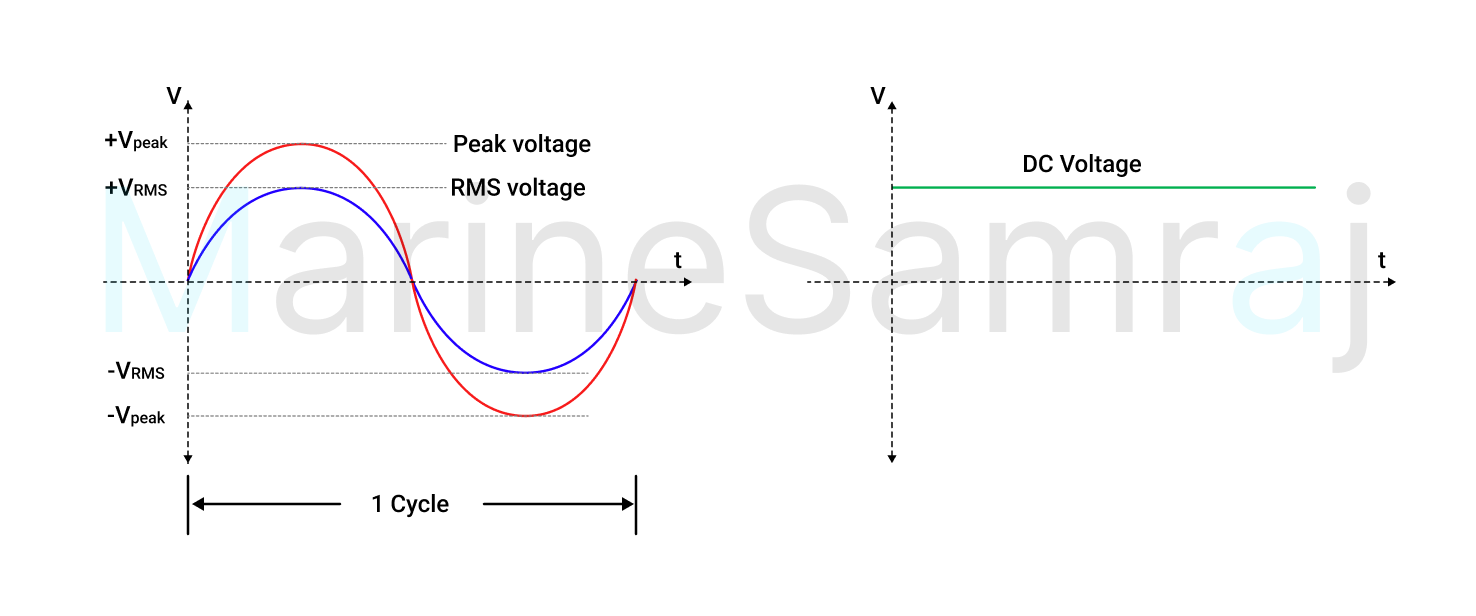
Exam question diagram

Reference Answer

(a) The root-mean-square (RMS) value of an alternating current (AC) or voltage waveform represents the equivalent DC value that would produce the same heating effect in a resistive load. In simpler terms, it's the effective value of the varying AC signal. For a sinusoidal waveform, the RMS value is 0.707 times the maximum (peak) value (Irms = 0.707 * Imax or Irms = Imax / √2). Ammeters and voltmeters typically measure the RMS value of current and voltage, respectively. Unless otherwise stated, values of AC current and voltage are assumed to be RMS values in electrical engineering.
The form factor of an AC waveform is the ratio of its RMS value to its average value. For a perfect sine wave, the form factor is approximately 1.11 (RMS value/Average Value = 1.11). This factor indicates how closely a waveform resembles a pure sine wave; a form factor closer to 1.11 suggests a waveform that is more sinusoidal.
← Browse more questions

Prepare on Android — MeoMock on Google Play