← MeoMock / Written exams
Class 2 (2nd Engineer) MEKG 📅 Jan 2025

Exam Question

Explain the working principle of differential pressure transmitter with the help of diagram, and explain the following parts with their usages: (16)

(a) High pressure connection

(b) Negative feedback bellow

(c) Pilot amplifier functions

(d) Zero elevation concept.
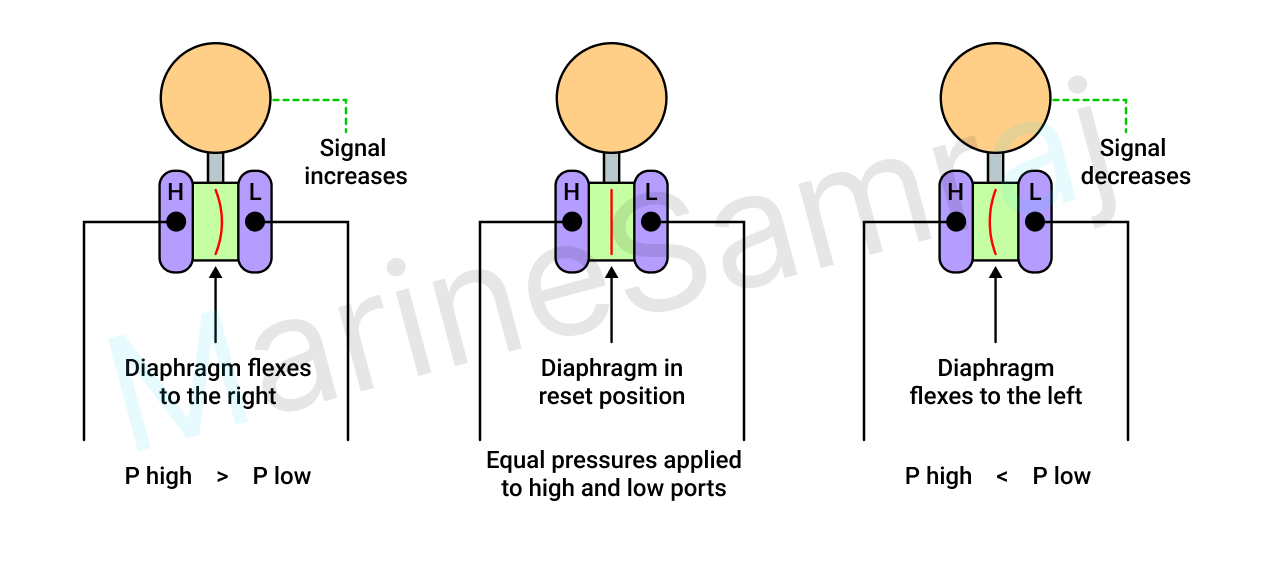
Exam question diagram

Reference Answer

### Working Principle of a Differential Pressure (DP) Transmitter
A Differential Pressure (DP) Transmitter is a robust instrument used to measure the difference in pressure between two points and convert this measurement into a standardized output signal, typically pneumatic (3-15 psi) or electrical (4-20 mA). The principle is based on the **Force-Balance Mechanism**.
1. **Sensing Element**: The core of the transmitter consists of two pressure chambers, designated High Pressure (HP) and Low Pressure (LP), separated by a flexible sensing diaphragm or bellows. Process pressures from two separate points are piped to these chambers.
2. **Force Generation**: The difference in pressure, $$ \Delta P = P_{HP} - P_{LP} $$, exerts a net force on the sensing diaphragm, causing it to deflect. This force is transmitted mechanically via a force bar or a similar lever system.

Full answer on MeoMock — surveyor-grade reference answers for 7,000+ written exam questions.

View plans Browse library

← Browse more questions

Prepare on Android — MeoMock on Google Play