← MeoMock / Written exams
Class 2 (2nd Engineer) MEKG 📅 Feb 2024

Exam Question

Explain the working principle of differential Pressure Transmitter with the help of diagram and explain the following parts with their usages. (16)

(a) Zero and span calibration

(b) Negative feedback bellow

(c) Pilot amplifier functions

(d) Zero Elevation Concept
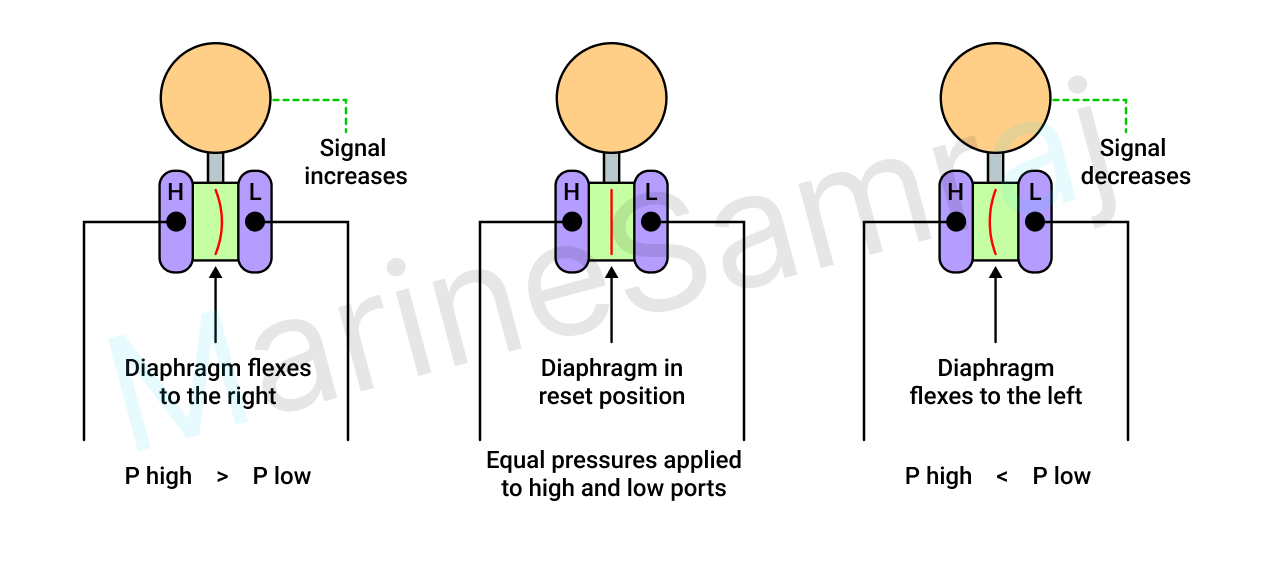
Exam question diagram

Reference Answer

### Working Principle of a Differential Pressure (DP) Transmitter (Pneumatic Force-Balance Type)
A Differential Pressure (DP) Transmitter is a device used to measure the difference in pressure between two points and convert this measurement into a standardized output signal (typically pneumatic 3-15 psi or 0.2-1.0 bar, or electrical 4-20 mA). The pneumatic force-balance type is a classic and robust design that operates on the principle of balancing forces to achieve a stable and accurate measurement.
**Core Principle:** The fundamental principle is that the force generated by the process differential pressure acting on a sensing diaphragm is continuously balanced by a counter-force generated by a negative feedback system. The magnitude of the feedback signal required to maintain this equilibrium becomes the output of the transmitter, directly proportional to the measured differential pressure.
**Construction & Operation:**

Full answer on MeoMock — surveyor-grade reference answers for 7,000+ written exam questions.

View plans Browse library

← Browse more questions

Prepare on Android — MeoMock on Google Play