← MeoMock / Written exams
Class 2 (2nd Engineer) MEKM 📅 Aug 2022

Exam Question

(a) Explain why highly efficient diesel engines tend to produce more NOx than low performance diesel engines.

(b) Describe, with the aid of a sketch, a Selective Catalytic Reduction (SCR) unit for a marine propulsion diesel engine

(c) Explain why accurate monitoring of the exhaust gas flows entering and leaving a Selective Catalytic Reduction unit are required and how these readings are used to control the reduction chemical supplied to the SCR unit.
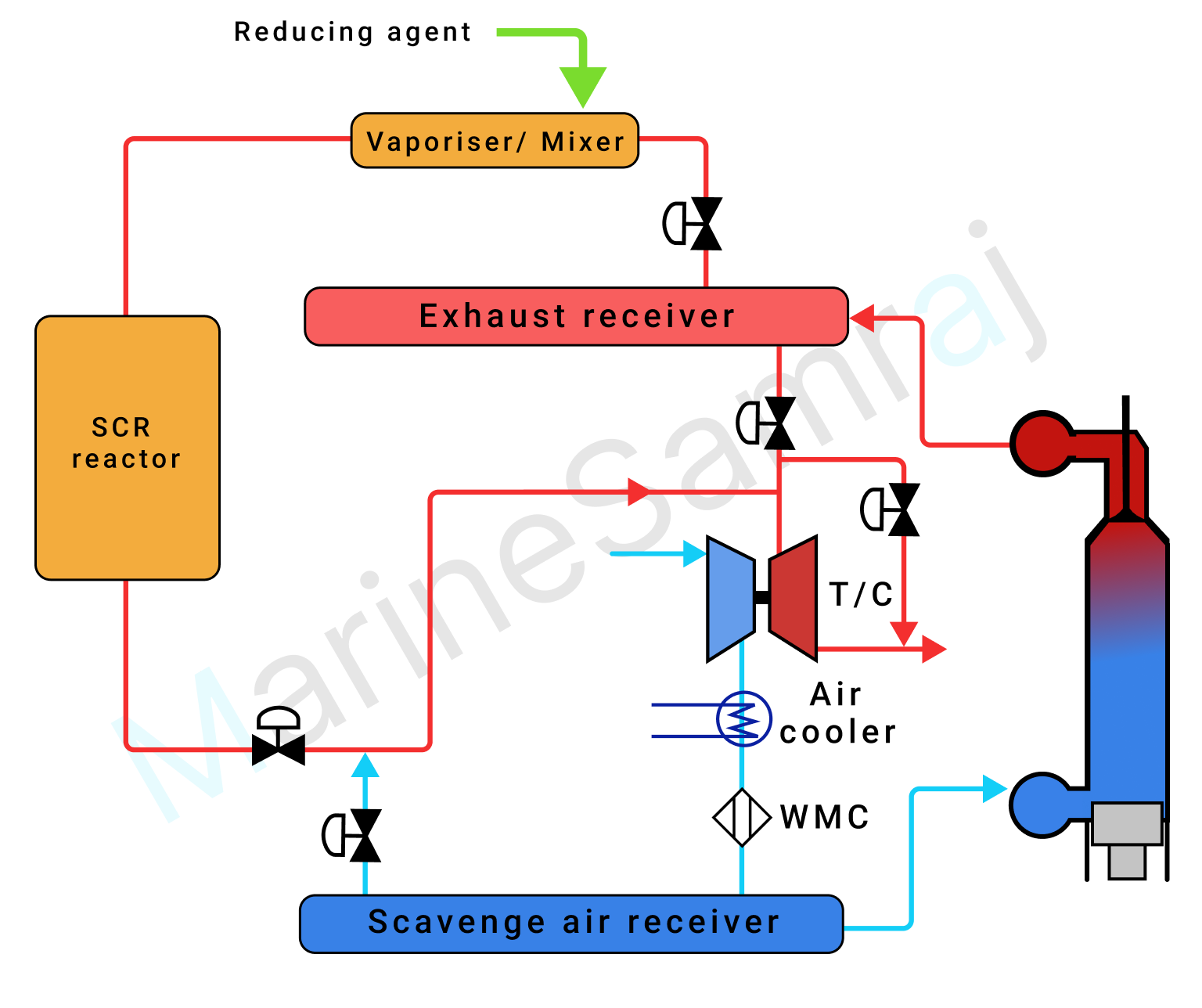
Exam question diagram

Reference Answer

(a) The formation of NOx depends particularly on the temperature of the combustion. Highly efficient engines operate at a higher temperature and pressure than normal diesel engines. Higher the temperature higher the emissions of NOx (because more energy promotes the chemical reaction). These conditions favour the production of NOx gases. The quantity depends on the volume and duration of the hottest part of the flame.
(b) SCR (Selective Catalytic Reduction) is a method used to control NOx emission. This method involves injection of a fine mist of urea plus water (called as Diesel Exhaust Fluid - DEF) into the engine’s exhaust system to create a chemical reaction to turn NOx into Nitrogen and Water Vapour.
DEF is a non-hazardous solution, which is 32.5% urea and 67.5% de-ionised water.
The SCR system consists of a reactor, catalyst elements, soot blower, sensors, air reservoir, mixing devices, dosing unit urea injection nozzle, urea pump and safety control system.

Full answer on MeoMock — surveyor-grade reference answers for 7,000+ written exam questions.

View plans Browse library

← Browse more questions

Prepare on Android — MeoMock on Google Play