← MeoMock / Written exams
Class 4 (4th Engineer) MET 📅 Oct 2025

Exam Question

In the following circuit E1 = 13 V, E2 = 19.5 V, R1 = 5Ω, R2 = 7Ω, R3 = 9Ω. Find the current flowing through each resistor. (16)
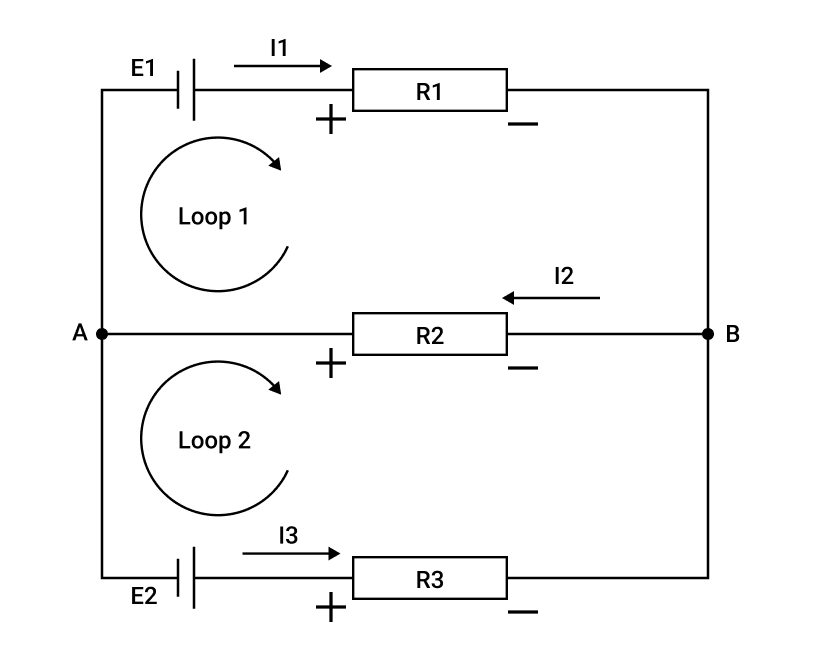
Exam question diagram

Reference Answer

### **Principle: Kirchhoff's Laws**
To determine the current flowing through each resistor in the given complex circuit, we must apply Kirchhoff's Laws. This is necessary because simple series/parallel resistor combinations cannot be used due to the presence of multiple voltage sources in different branches.
1. **Kirchhoff's Current Law (KCL) / The Junction Rule:** This law is based on the principle of conservation of charge. It states that the algebraic sum of currents entering any junction (or node) in a circuit is equal to the algebraic sum of currents leaving that junction. Essentially, $$ \sum I_{in} = \sum I_{out} $$.
2. **Kirchhoff's Voltage Law (KVL) / The Loop Rule:** This law is based on the principle of conservation of energy. It states that the algebraic sum of the changes in potential (voltages) around any closed loop in a circuit must be zero. This means the sum of the electromotive forces (EMFs) in a closed loop equals the sum of the potential drops (I × R) across the resistors in that same loop. Essentially, $$ \sum V = 0 $$ or $$ \sum EMF = \sum (I \times R) $$.

Full answer on MeoMock — surveyor-grade reference answers for 7,000+ written exam questions.

View plans Browse library

← Browse more questions

Prepare on Android — MeoMock on Google Play