← MeoMock / Written exams
Class 2 (2nd Engineer) MET 📅 Mar 2018

Exam Question

(a) What is a commutator? Discuss its rectifying action in detail. (8)

(b) Calculate the e.m.f. generated by a 4-pole, wave wound armature having 40 slots with 18 conductors per slot when driven at 1000 r.p.m. The flux per pole is 0.015 wb. (8)
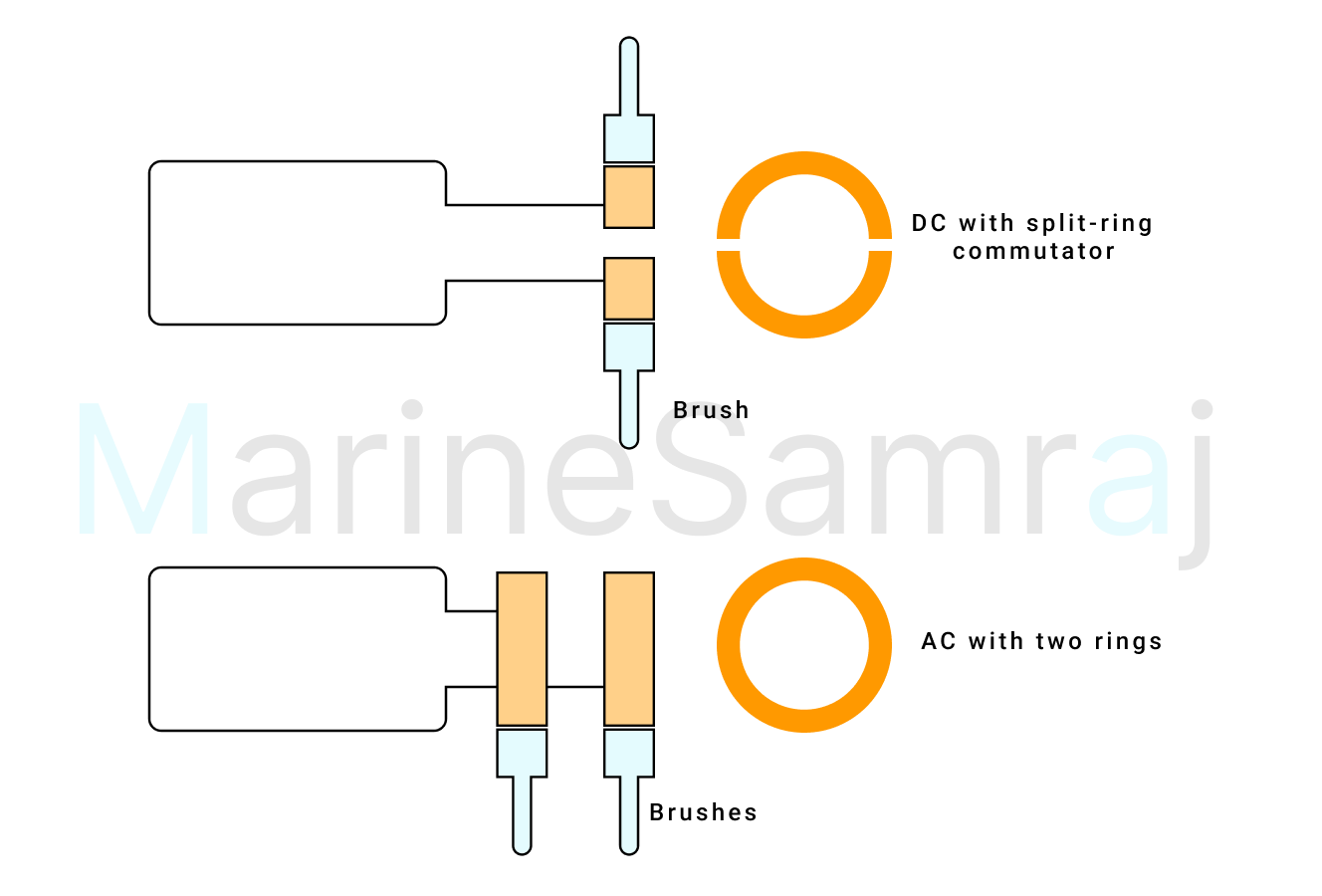
Exam question diagram

Reference Answer

(a) A commutator is a rotating electrical switch in DC machines that converts alternating current (AC) generated in the armature windings into direct current (DC) at the output terminals. It achieves this through a process called commutation.
Rectifying Action of a Commutator:
The armature windings of a DC generator produce an AC voltage. To obtain a unidirectional (DC) voltage at the output terminals, a commutator is used. The commutator consists of multiple copper segments insulated from each other and mounted on the shaft. The ends of the armature coils are connected to these segments. Carbon brushes rest on the commutator, making contact with different segments as the commutator rotates.
As the armature rotates, the voltage induced in each coil alternates. However, the commutator segments are arranged such that when the voltage in a coil reverses, the brushes switch to contact a different set of commutator segments, connected to the coil's opposite ends. This switching action effectively reverses the coil's connections to the output terminals, thereby rectifying the alternating voltage into a pulsating direct current.

Full answer on MeoMock — surveyor-grade reference answers for 7,000+ written exam questions.

View plans Browse library

← Browse more questions

Prepare on Android — MeoMock on Google Play