← MeoMock / Written exams
Class 2 (2nd Engineer) MEP 📅 Feb 2024

Exam Question

With reference to fatigue in crankshafts explain:

(a) Why, larger shafts are more susceptible to fatigue faiulure than their smaller counterparts. (5)

(b) With sketches how it is inhibited in practice.(5)

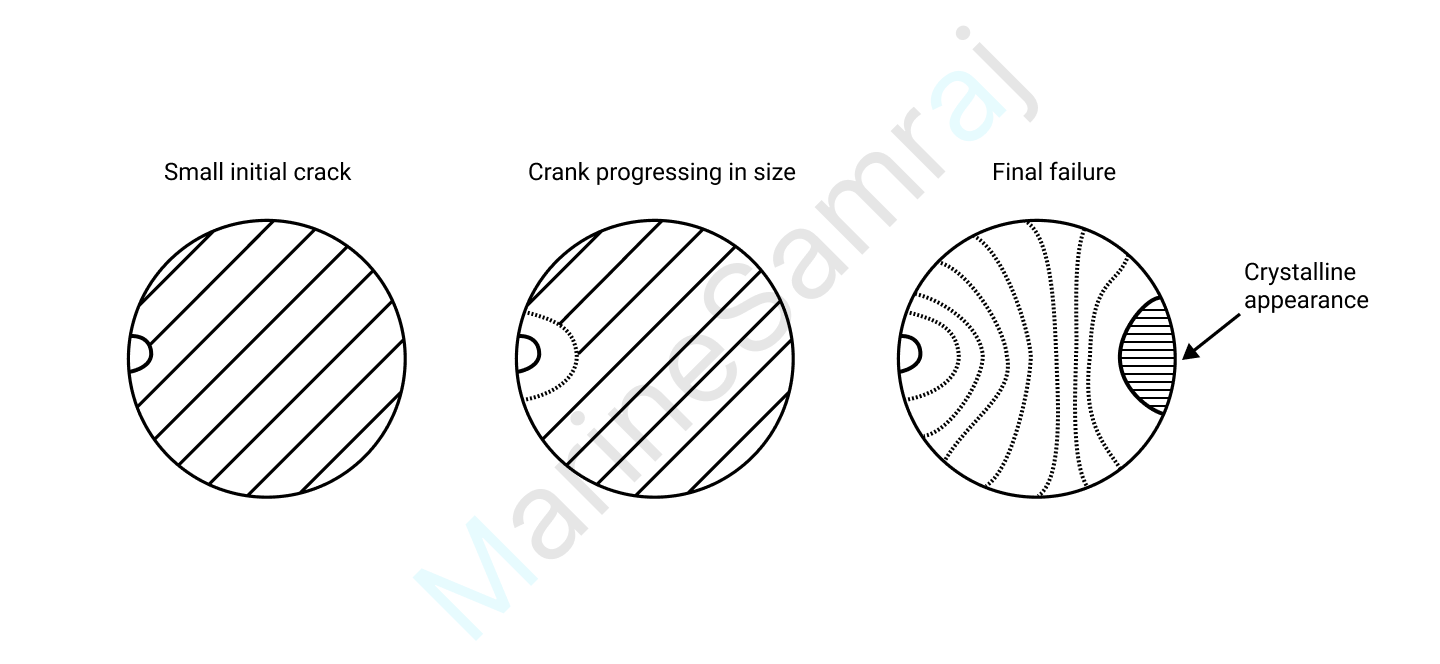
(c) How it is identified in its initial, intermediate and final stages prior to failure. (6)
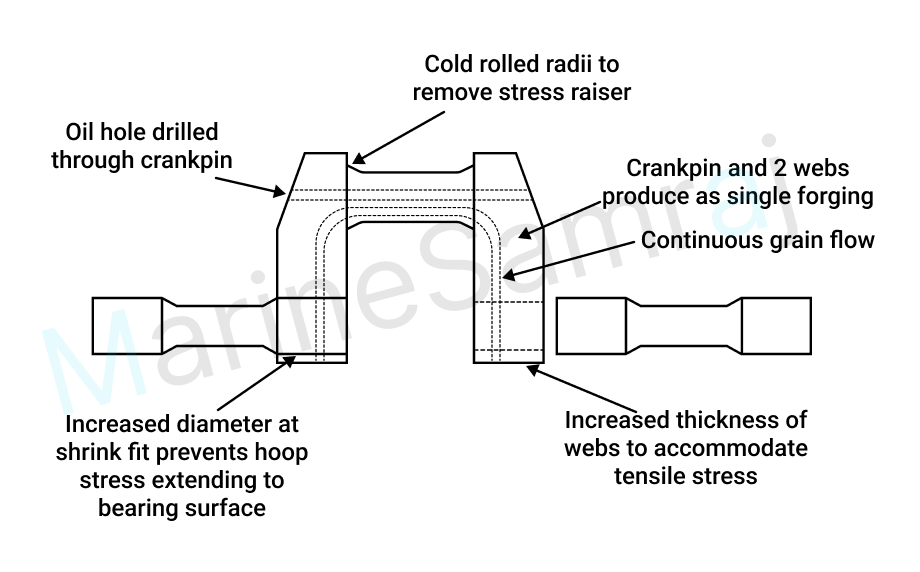
Exam question diagramExam question diagram

Reference Answer

(a) Fatigue in Crankshafts
Fatigue failure occurs when a crankshaft section is subjected to cyclic stress reversals . Over time, the material's properties deteriorate, weakening its ability to withstand tensile stress, leading to crack initiation . With continued operation and stress reversals, this crack progressively grows until complete failure occurs.
Smaller crankshafts , such as those in 4-stroke medium-speed engines, are typically solid forged , with a continuous grain line structure . This enhances fatigue resistance and overall strength.
Larger crankshafts , as used in 2-stroke slow-speed crosshead engines, are often semi-built or fully built . These are fabricated from separate forged crank throws, with main journals shrink-fitted into machined holes in the webs. While the crank throw may have continuous grain flow, the shrink-fit areas are potential weak spots .

Full answer on MeoMock — surveyor-grade reference answers for 7,000+ written exam questions.

View plans Browse library

← Browse more questions

Prepare on Android — MeoMock on Google Play