← MeoMock / Written exams
Class 2 (2nd Engineer) MET 📅 Sep 2018

Exam Question

With reference to Marine Electrical circuits:

(a) Explain three methods of overeurrent protection for electrical circuit

(b) Explain with aid of diagram, the meaning of the term inverse current time characteristic.
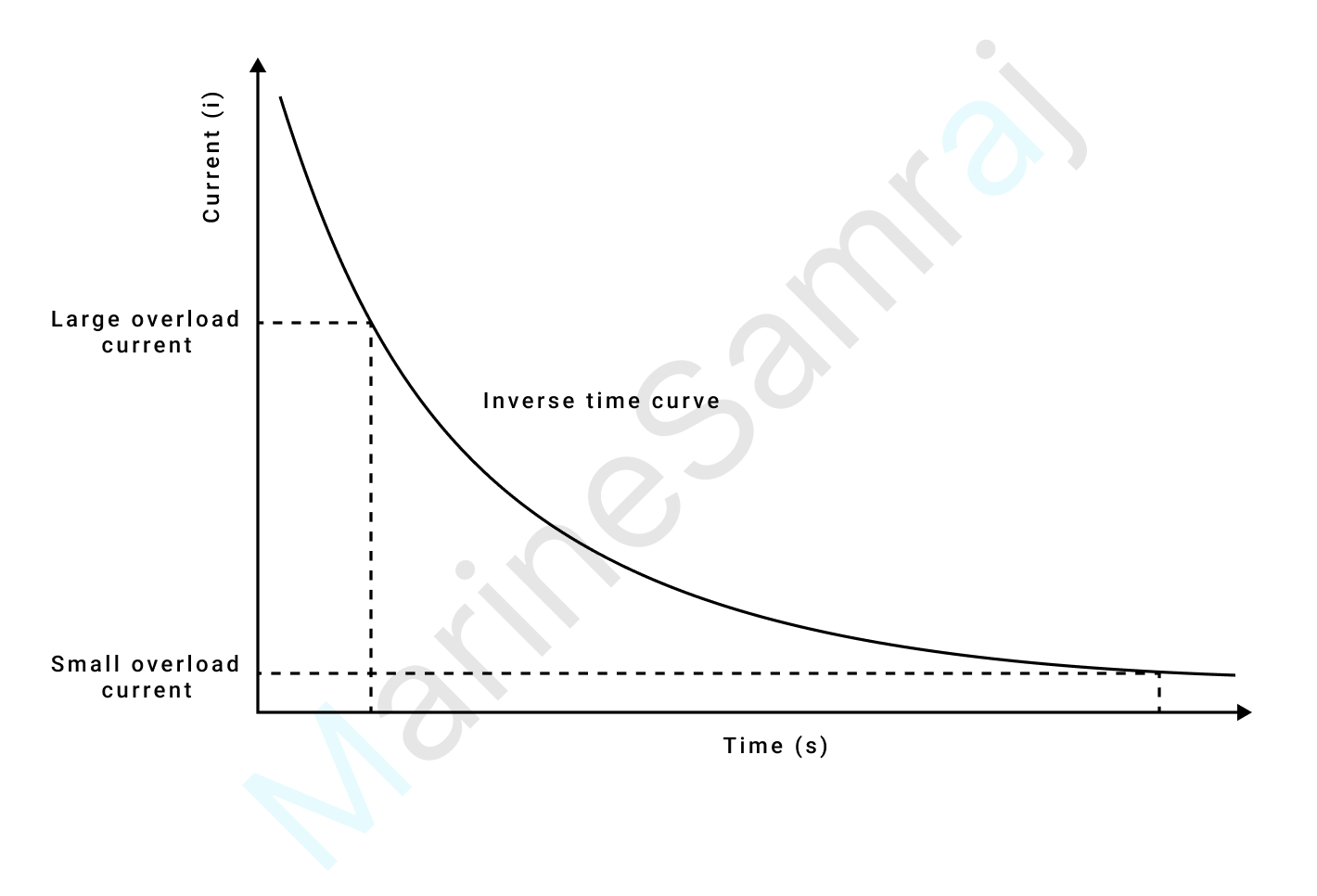
Exam question diagram

Reference Answer

(a) Three methods of overcurrent protection:
Fuses are one of the simplest forms of overcurrent protection. They operate on the principle of the heating effect of electric current. A fuse is made of a thin metallic wire with a low melting point and non-combustible material. When an excessive current flows through the circuit, it generates heat, causing the fuse to melt and thereby interrupting the circuit. This effectively protects the circuit components from damage. Fuses are commonly used as backup protection against short circuits in motors and for cable protection.
A thermal overload relay works on the electro-thermal properties of a bimetallic strip. In this system, the bimetallic strip is placed in the motor circuit so that the current flowing through the motor also passes through the relay. As the current increases, the strip heats up, and if the current exceeds a preset limit, the strip bends due to thermal expansion. This action opens the circuit, providing protection against overloading. Thermal overload relays are widely used to safeguard motors from conditions that could result in overheating due to excessive current.
An electronic overcurrent relay uses advanced microprocessor-based technology combined with temperature sensors or current transformers to sense the current flowing through a circuit. These relays often employ a Positive Temperature Coefficient (PTC) thermistor to detect overheating conditions. When the temperature or current exceeds the set threshold, the relay trips and interrupts the circuit. This type of relay is always used in combination with a contactor and is connected in line with the motor, allowing the entire motor current to flow through it. Electronic overcurrent relays are particularly suited for applications where motors need to start and stop frequently, offering reliable and precise protection.

Full answer on MeoMock — surveyor-grade reference answers for 7,000+ written exam questions.

View plans Browse library

← Browse more questions

Prepare on Android — MeoMock on Google Play