← MeoMock / Written exams
Class 2 (2nd Engineer) MEP 📅 Aug 2025

Exam Question

Write short note on the following:

(a) Metal-locking

(b) TIG and MIG welding

(c) Brazing

(d) Soldering
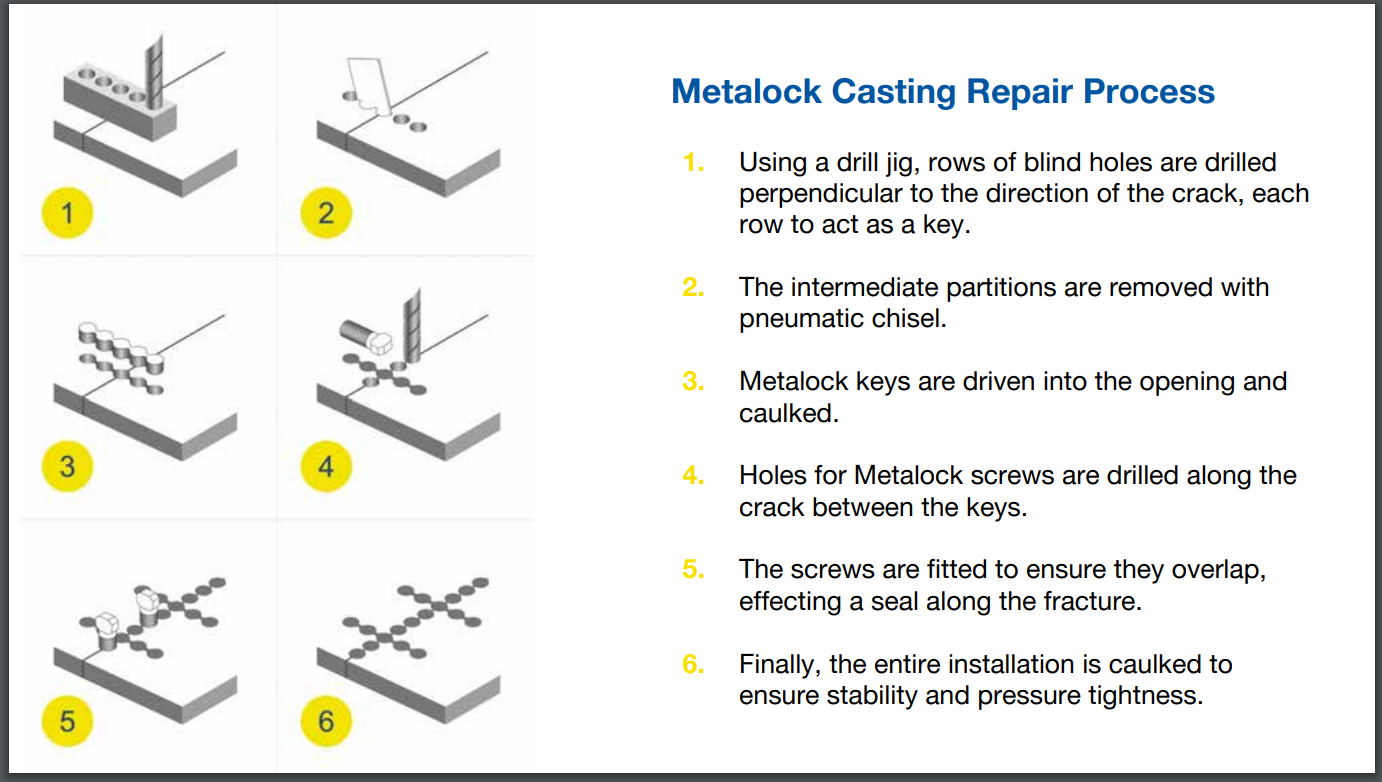
Exam question diagram

Reference Answer

(a) Metal locking is a cold-working repair method for fractured castings. The process involves precisely aligning and clamping the fractured pieces. A series of holes are drilled perpendicular to the crack and then shaped to accept interlocking metal keys. These keys are inserted, followed by studs driven into the holes, each stud biting into the preceding one to create a tight, secure join. Finally, the studs and keys are ground smooth for a polished finish. This method avoids the use of heat.
(b) TIG (Tungsten Inert Gas Welding): TIG welding uses a non-consumable tungsten electrode and an inert shielding gas (Argon or Helium) to protect the weld from atmospheric contamination. A filler metal is often, but not always, used. A constant-current power supply creates an arc, ionising the gas and metal vapour to fuse the materials. TIG welding is ideal for thin sections of stainless steel and non-ferrous metals like aluminium, magnesium, and copper alloys. It produces high-quality welds but is slower and more complex than other methods.
MIG (Metal Inert Gas Welding): MIG welding uses a consumable wire electrode that melts and fuses with the workpiece material. A shielding gas is also used to protect the weld. Both AC and DC currents can be employed. MIG welding is suitable for steel, aluminium, and other non-ferrous materials. Its advantages include faster welding speed and easier automation.
(c) Brazing is a metal-joining process that utilises a filler metal with a lower melting point than the base metals being joined. The filler metal flows into the joint by capillary action. High-quality brazing requires close-fitting parts and exceptionally clean surfaces free from oxides. A flux is used to clean the surfaces and facilitate filler metal flow. Brazing can join dissimilar metals like aluminium, silver, copper, gold, and nickel. While it offers the ability to join dissimilar metals, brazed joints are generally not as strong as welded joints.

Full answer on MeoMock — surveyor-grade reference answers for 7,000+ written exam questions.

View plans Browse library

← Browse more questions

Prepare on Android — MeoMock on Google Play